Self Attention
문장 내부에서 자기자신과


Cross Attention
Cross-Attention은 Transformer 모델에서 디코더가 인코더의 출력을 참조하여 정보를 얻는 메커니즘입니다. 이는 디코더가 현재 생성 중인 출력과 관련된 입력의 부분에 집중할 수 있게 도와줍니다. 예를 들어, 기계 번역에서 영어 문장을 힌디어로 번역할 때, 디코더는 이미 생성된 단어들과 입력 문장의 관련 부분을 동시에 고려하여 다음 단어를 생성합니다.
- 입력 준비:
- 두 개의 입력 시퀀스(예: 이미지 패치 시퀀스와 텍스트 시퀀스)를 준비합니다.
- Query, Key, Value 생성:
- 디코더의 출력에서 Query를 생성하고, 인코더의 출력에서 Key와 Value를 생성합니다.GeeksforGeeks
- Attention 계산:
- Query와 Key의 내적을 계산하고, 소프트맥스를 적용하여 Attention 가중치를 얻습니다.
- 이 가중치를 Value에 곱하여 최종 출력을 생성합니다.
이러한 메커니즘은 이미지 캡셔닝, 텍스트 요약, 질의 응답 시스템 등 다양한 분야에서 활용됩니다.
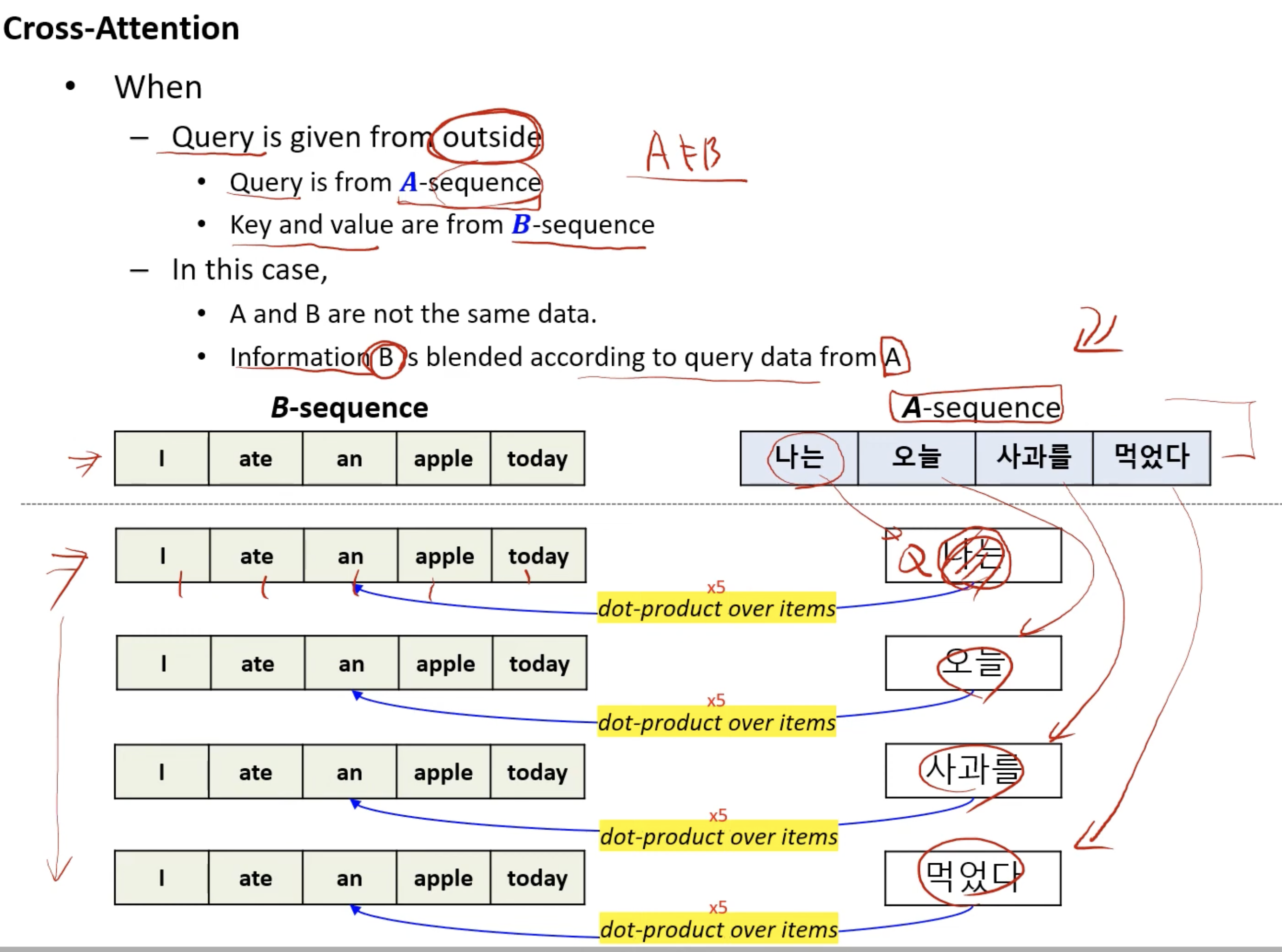
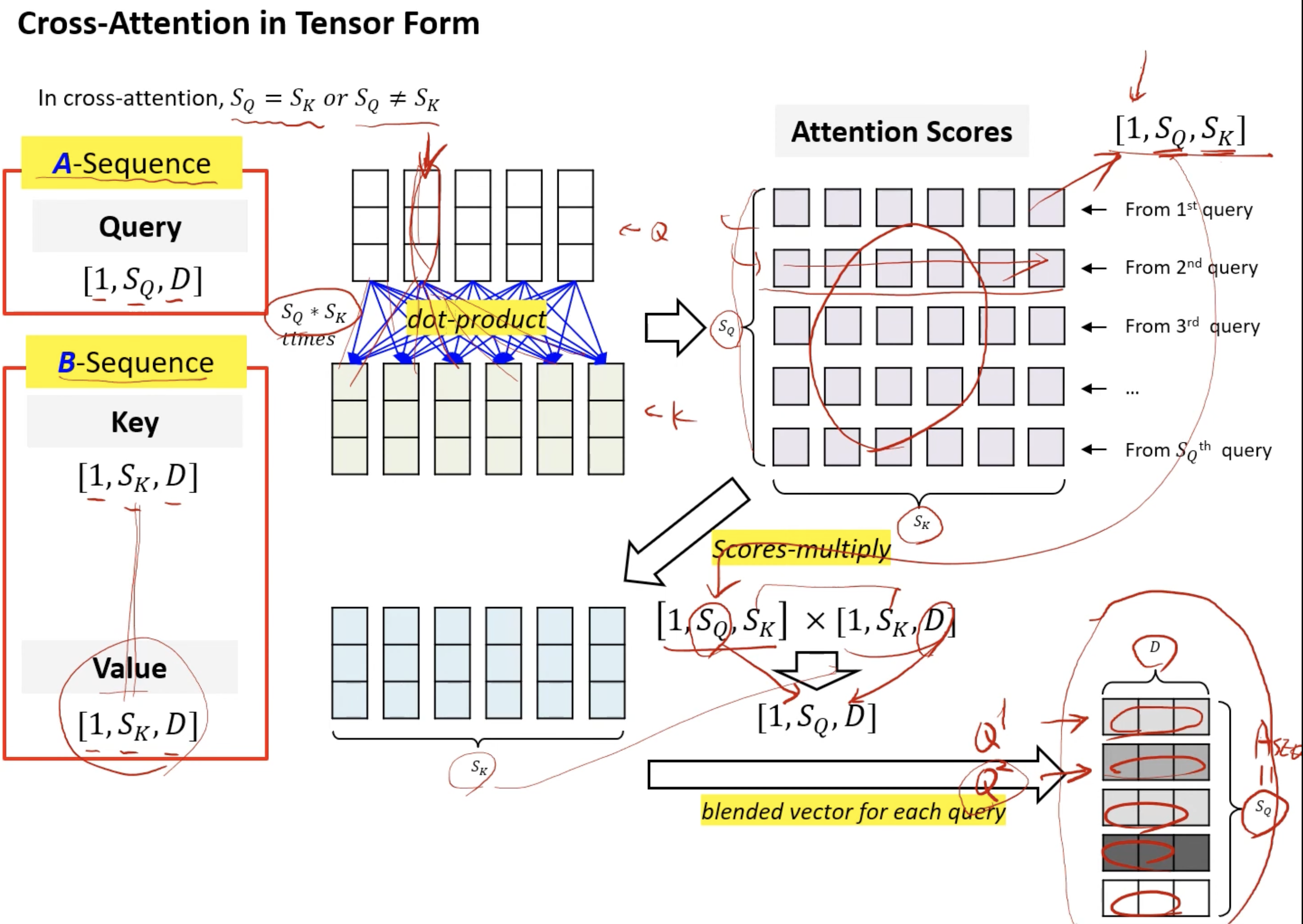
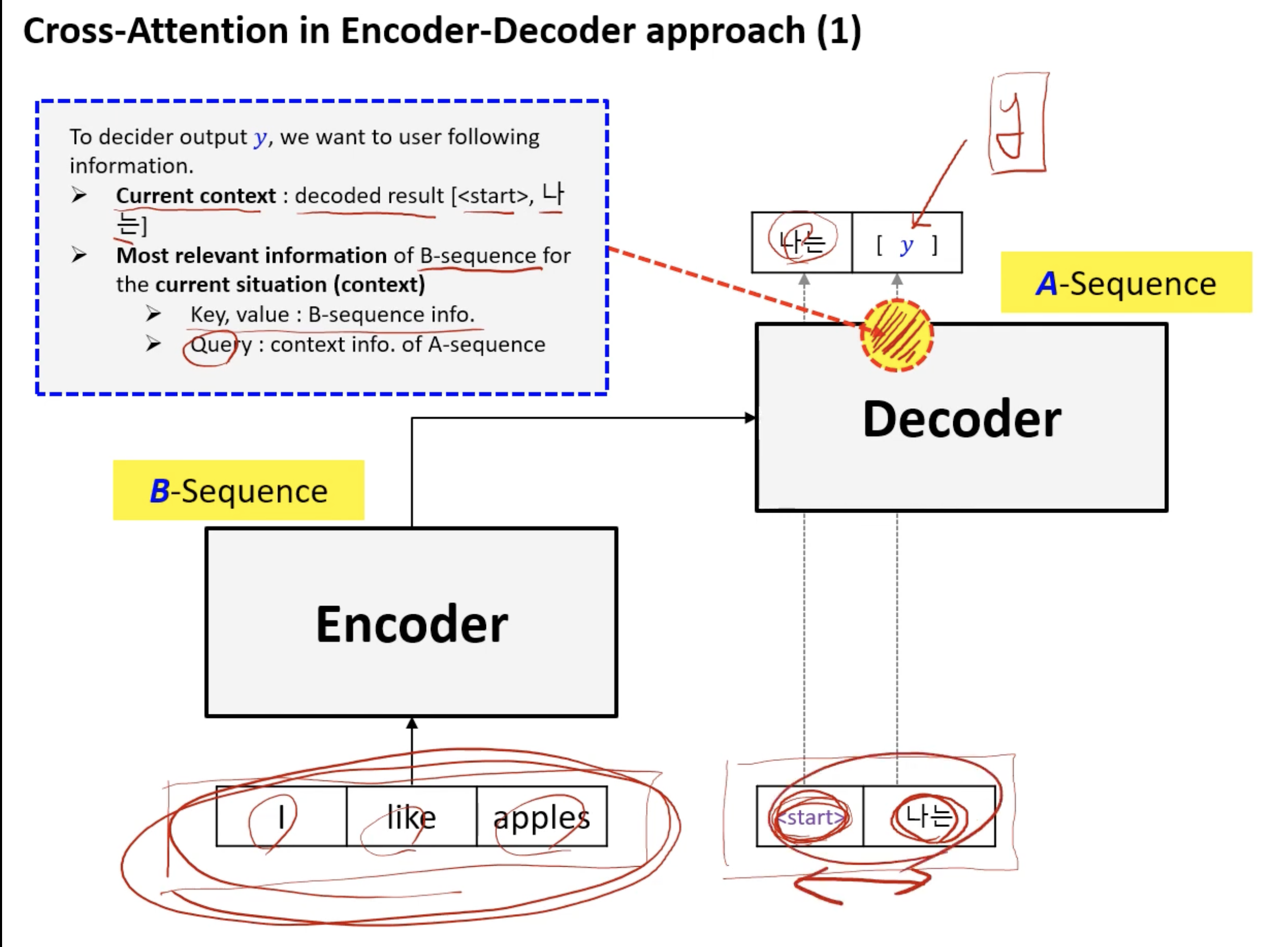
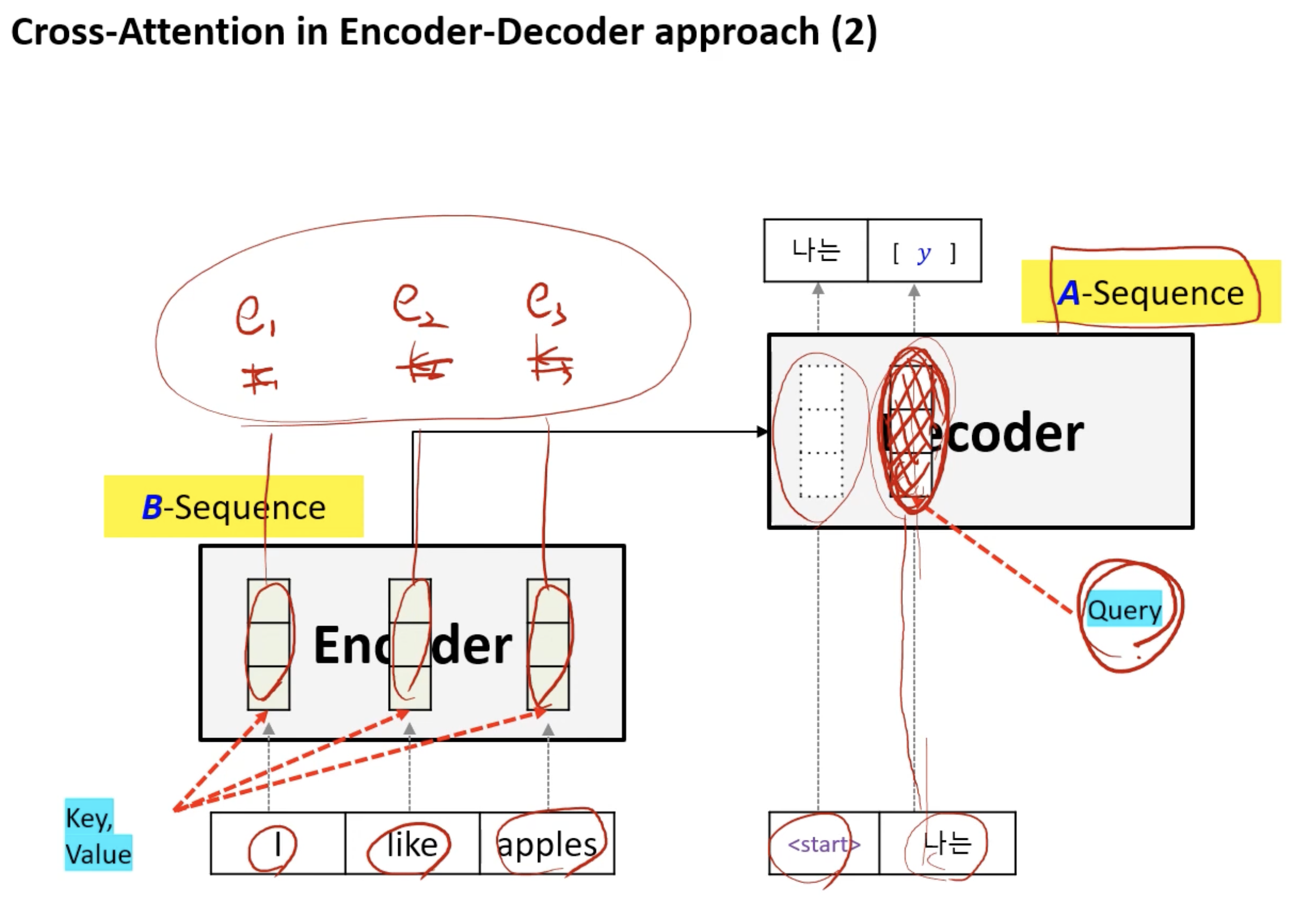
query : decoding,
key, value : encoding 에서 온다고 보면 됨
이미지를 cross attention으로 입력하는 방법은 주로 두 이미지(혹은 이미지와 텍스트 등 서로 다른 modality)를 Transformer 기반 네트워크에서 서로의 정보를 주고받게 하는 방식입니다. 최근 diffusion 모델, 이미지 편집, 멀티모달 학습 등에서 활발히 응용되고 있습니다.
아래는 대표적인 구현 방식과 참고 자료입니다.
1. 기본 원리
- **cross attention**은 Query, Key, Value 중 일부를 서로 다른 입력(예: 두 이미지, 이미지-텍스트)에서 가져와 정보를 교환합니다.
- 예시:
- Query: 주 이미지(혹은 구조 이미지) feature
- Key/Value: 다른 이미지(혹은 appearance 이미지) feature
- 이 과정을 통해 한 이미지의 특성(구조, appearance 등)이 다른 이미지에 반영됩니다145.
2. 대표 구현 예시
a. Cross-Image Attention for Appearance Transfer
- 구조 이미지의 feature를 Query로, 스타일(appearance) 이미지의 feature를 Key/Value로 사용
- diffusion 모델의 denoising 과정에서 cross attention layer를 삽입
- 두 이미지의 feature map을 각각 인코더로 추출한 뒤, cross attention 연산을 적용
b. Deep Metric Learning에서의 Cross Attention
- 이미지 쌍의 feature map을 뽑아, 한 이미지의 embedding을 다른 이미지에 조건(conditioning)하도록 cross attention 적용
- 반복적으로 cross attention block을 쌓아 점진적으로 정보를 융합2
c. Diffusion/이미지 편집에서의 Cross Attention Control
- diffusion 모델의 cross attention map을 직접 수정해 prompt-to-prompt 이미지 편집, 이미지-이미지 효과 적용3
- 예: 한 이미지의 특정 부분에만 다른 이미지의 스타일을 반영
3. 참고 자료 및 논문
- Cross-Image Attention for Zero-Shot Appearance Transfer (arXiv:2311.03335)4
- 공식 구현 코드 (GitHub)5
- CVPR 2023: Cross-Image-Attention for Conditional Embeddings in Deep Metric Learning (Kotovenko et al.)2
- Prompt-to-Prompt Image Editing with Cross Attention Control (velog)3
요약
- 이미지를 cross attention으로 넣으려면, 두 이미지의 feature map을 각각 인코딩한 뒤, 한 쪽을 Query, 다른 쪽을 Key/Value로 사용해 cross attention 연산을 적용하면 됩니다.
- diffusion 모델, 이미지 편집, 멀티모달 학습 등 다양한 분야에서 실제 적용 사례와 코드가 공개되어 있습니다1245.
가장 실용적인 구현 예시와 논문은 "Cross-Image Attention for Zero-Shot Appearance Transfer"와 그 공식 GitHub 저장소를 참고하면 좋습니다.
Citations:
- https://garibida.github.io/cross-image-attention/
- https://openaccess.thecvf.com/content/CVPR2023/papers/Kotovenko_Cross-Image-Attention_for_Conditional_Embeddings_in_Deep_Metric_Learning_CVPR_2023_paper.pdf
- https://velog.io/@yell0315/Prompt-to-Prompt-Image-Editing-with-Cross-Attention-Control
- https://arxiv.org/abs/2311.03335
- https://github.com/garibida/cross-image-attention
- https://web.stanford.edu/class/cs224n/final-reports/256711050.pdf
- https://openaccess.thecvf.com/content_CVPR_2020/papers/Wei_Multi-Modality_Cross_Attention_Network_for_Image_and_Sentence_Matching_CVPR_2020_paper.pdf
- https://arxiv.org/html/2404.02747v1
- https://paperswithcode.com/paper/cross-image-attention-for-conditional
- https://www.youtube.com/watch?v=aw3H-wPuRcw
"Cross-Image Attention for Zero-Shot Appearance Transfer" 논문과 코드의 핵심 내용을 요약하고, 실용적인 구현 방법을 안내합니다.
1. 논문 핵심 아이디어
- 목적: 한 이미지의 **외관(appearance)**을 다른 이미지의 **구조(structure)**에 자연스럽게 전이 (예: 사과 → 오렌지 텍스처 전이)
- 방법:
- 두 이미지(구조 이미지 $I_s$, 외관 이미지 $I_a$)를 diffusion 모델에 입력
- **Cross-image attention layer**를 통해 $I_a$의 외관 정보를 $I_s$의 구조에 융합
- 사전 학습된 diffusion 모델(Stable Diffusion)을 활용해 zero-shot 학습 없이 즉시 적용 가능
2. 코드 구현 구조 (GitHub 링크)
주요 파일/기능
- pipeline_pasd.py: 이미지 전이를 위한 커스텀 파이프라인
- cross_image_attention.py: cross-attention 모듈 구현
- configs/: 모델 설정(YAML 파일)
Key Code Snippet
3. 사용 방법
환경 설정
실행 예시
4. 주요 특징
- 강점:
- Zero-shot 전이: 추가 학습 없이 즉시 적용 가능
- 고화질 결과: 512x512 해상도 지원
- 부분 전이: 마스크를 통해 특정 영역만 외관 전이 가능
- 제한점:
- GPU 메모리 12GB 이상 권장 (RTX 3090 기준)
- 복잡한 구조(인물 포즈 등) 전이 시 한계 존재
5. 활용 예시
- 스타일 전이: 풍경화 → 사진 스타일 변환
- 텍스처 합성: 동물 무늬 → 의류 디자인
- 의료 이미징: MRI → CT 구조 변환 (도메인 adaptation)
결론: 이 코드는 구조-외관 분리 학습 없이 즉시 이미지 전이를 수행할 수 있어 실험적 적용이 용이합니다. 논문의 cross-image attention 메커니즘을 이해하려면 cross_image_attention.py의 AttentionMap 계산 로직을 중점적으로 분석하세요.
Left/Right Depth에 Cross Attention을 적용한 주요 사례 및 논문
Stereo 이미지 처리(깊이 추정, 초해상도, 압축 등)에서 Left/Right Depth에 Cross Attention을 적용한 연구는 최근 활발히 진행되고 있습니다. 주요 사례를 정리합니다.
1. Stereo Image Super-Resolution (SISR)
- 논문: Hybrid Cross-View Attention Network (HCVAN)
- 방법: Left/Right 이미지의 intra-view feature를 추출한 후, cross-view attention으로 두 뷰의 정보를 융합하여 초해상도 복원
- 특징: Epipolar geometry 제약을 활용해 효율적인 attention 계산
2. Stereo Depth Estimation
- 논문: Context-Enhanced Stereo Transformer (CEST)
- 방법: Self-attention 후 cross-attention 모듈을 적용해 좌우 이미지 간의 깊이 차이(disparity) 예측
- 장점: Textureless 영역에서도 강건한 깊이 추정
- 논문: Gated Cross-Attention Network for Depth Completion
- 방법: RGB 이미지와 sparse depth를 cross-attention으로 융합하여 dense depth 완성
- 특허: Confidence propagation과 결합해 깊이의 신뢰도 향상
3. Stereo Image Compression
- 논문: ECSIC: Epipolar Cross Attention
- 방법: 좌우 이미지의 epipolar line 제약 하에서 cross-attention 수행
- 효과: Stereo redundancy 감소로 압축률 극대화
4. Multi-View Depth Estimation
- 논문: Cross-View Completion Models (ZeroCo)
- 방법: Cross-attention map을 활용해 zero-shot geometric correspondence 및 깊이 추정
- 장점: 사전 학습 없이도 multi-view 깊이 예측 가능
5. Cross-Spectral Depth Fusion
- 논문: Cross-spectral Gated-RGB Stereo Depth Estimation
- 방법: RGB와 gated 이미지의 cross-spectral feature를 cross-attention으로 융합
- 성능: 100m 이상 장거리 깊이 추정 정확도 39% 향상
공통 기술 요소
- Epipolar Geometry 활용: 좌우 이미지의 기하학적 제약을 attention 계산에 반영
- Sparse vs. Dense Attention: Locality-sensitive hashing(LSH) 등으로 계산 효율성 확보
- Multi-Modal Fusion: RGB, 깊이, IR 등을 cross-attention으로 결합
결론: Stereo 깊이 처리 분야에서 cross-attention은 좌우 뷰 간의 상관관계 추출과 다중 모달리티 융합의 핵심 메커니즘으로 자리잡았습니다.
cross-attention을 활용한 스테레오 이미지 기반의 depth estimation은 최근 연구에서 활발히 탐구되고 있습니다. 이러한 접근 방식은 좌우 이미지 간의 정보를 효과적으로 결합하여 더 정확한 깊이 예측을 가능하게 합니다.
Cross-Attention을 활용한 스테레오 이미지 기반 Depth Estimation 사례
- Cross-Spectral Gated-RGB Stereo Depth Estimation
이 연구에서는 서로 다른 스펙트럼(RGB와 Gated 이미지)의 스테레오 이미지를 활용하여 깊이를 추정합니다. cross-attention 메커니즘을 통해 두 이미지 간의 상호 정보를 효과적으로 결합하여 깊이 예측의 정확도를 높였습니다. - Cross-View Completion Models
이 모델은 서로 다른 시점의 이미지 간의 상호 보완적인 정보를 활용하여 깊이를 예측합니다. cross-attention 맵을 통해 두 이미지 간의 대응 관계를 학습하며, 이를 통해 깊이 정보를 추정합니다. - Stereo Transformer (STTR)
이 모델은 self-attention과 cross-attention을 결합하여 스테레오 이미지 간의 정밀한 대응 관계를 학습합니다. 이를 통해 깊이 예측의 정확도를 향상시킵니다.
Cross-Attention을 활용한 Depth Estimation의 장점
- 정확한 대응 관계 학습: cross-attention은 좌우 이미지 간의 정밀한 대응 관계를 학습하여 깊이 예측의 정확도를 높입니다.
- 다양한 시점 정보 통합: 서로 다른 시점의 이미지를 효과적으로 결합하여 더 풍부한 깊이 정보를 얻을 수 있습니다.
- 복잡한 장면 처리 능력 향상: cross-attention을 통해 occlusion이나 textureless 영역에서도 보다 안정적인 깊이 예측이 가능합니다.(arXiv)
추가 학습 자료
- 논문:
- Cross-Spectral Gated-RGB Stereo Depth Estimation
- Cross-View Completion Models are Zero-shot Correspondence Estimators
- Stereo Transformer(light.princeton.edu, arXiv, GitHub)
- 코드 및 구현:
Stereo depth estimation에서 cross-attention을 활용한 연구들은 다양한 방식으로 left와 right 이미지 간의 정보를 통합하여 정확한 depth 예측을 시도하고 있습니다. 이러한 접근법들은 특히 복잡한 장면이나 다양한 조명 조건에서의 성능 향상에 기여하고 있습니다.
Cross-Attention을 활용한 Stereo Depth Estimation 연구 사례
1. STereo TRansformer (STTR)
STTR은 left와 right 이미지의 epipolar line 상의 픽셀 간 대응을 찾기 위해 cross-attention을 활용합니다. 이 접근법은 고정된 disparity 범위의 제한을 완화하고, occlusion 영역을 식별하며, 매칭 과정에서의 유일성 제약을 적용합니다. 이러한 특성들은 다양한 도메인에서의 일반화 성능을 향상시키는 데 기여합니다. (CVF Open Access)
2. Cross-spectral Gated-RGB Stereo Depth Estimation
이 연구는 서로 다른 스펙트럼(예: 가시광선과 근적외선)에서 촬영된 이미지 쌍을 활용하여 depth를 예측합니다. cross-spectral fusion 모듈을 통해 두 이미지의 특징을 정렬하고, attention 기반의 feature fusion을 수행하여 다양한 조명 조건에서도 정확한 depth 맵을 생성합니다. (CVF Open Access)
3. ChiTransformer
ChiTransformer는 self-supervised 학습을 통해 stereo depth를 추정하는 모델로, gated positional cross-attention(GPCA) 레이어를 도입하여 left와 right 이미지 간의 특징을 효과적으로 통합합니다. 이 접근법은 특히 dynamic하거나 복잡한 환경에서의 depth 추정 성능을 향상시킵니다. (arXiv)
Cross-Attention 기반 Loss 설정
cross-attention을 활용한 stereo depth estimation에서는 일반적으로 다음과 같은 loss 함수들이 사용됩니다:
- Reconstruction Loss (L1 또는 L2): 예측된 depth를 기반으로 한 이미지 재구성을 원본 이미지와 비교하여 계산합니다.
- Perceptual Loss (예: LPIPS): 재구성된 이미지와 원본 이미지 간의 고차원 특징 차이를 측정하여 시각적 유사성을 평가합니다.
- Smoothness Loss: depth 맵의 공간적 연속성을 유지하기 위해 인접 픽셀 간의 depth 차이를 최소화합니다.
- Occlusion-aware Loss: occlusion 영역을 고려하여 해당 영역의 loss 기여도를 조절하거나 제외합니다.
예를 들어, STTR에서는 cross-attention을 통해 얻은 매칭 정보를 기반으로 disparity를 예측하고, 이를 통해 위의 loss 함수들을 적용하여 모델을 학습시킵니다.(CVF Open Access)
Input 및 Output 형태
- Input: 정렬된 left와 right 이미지 쌍. 일반적으로 동일한 해상도를 가지며, epipolar geometry에 따라 정렬되어야 합니다.(arXiv)
- Output: 각 픽셀에 대한 disparity 또는 depth 값으로 구성된 맵. 이 맵은 left 이미지의 각 픽셀에 대해 대응하는 right 이미지의 픽셀 위치를 나타내며, 이를 통해 3D 구조를 복원할 수 있습니다.
관련 자료 및 학습 리소스
- 논문:
- 코드 및 구현:
- 학습 자료:
출처 : https://youtu.be/514eZBF8DkE?si=CMLYCdTN81yF7NV3
Citations:
- https://openaccess.thecvf.com/content/CVPR2024W/NTIRE/papers/Yang_Hybrid_Cross-View_Attention_Network_for_Lightweight_Stereo_Image_Super-Resolution_CVPRW_2024_paper.pdf
- https://openaccess.thecvf.com/content/CVPR2024/papers/Brucker_Cross-spectral_Gated-RGB_Stereo_Depth_Estimation_CVPR_2024_paper.pdf
- https://www.ecva.net/papers/eccv_2022/papers_ECCV/papers/136920263.pdf
- https://openaccess.thecvf.com/content/CVPR2023W/NTIRE/papers/Zhou_Stereo_Cross_Global_Learnable_Attention_Module_for_Stereo_Image_Super-Resolution_CVPRW_2023_paper.pdf
- https://arxiv.org/html/2406.10581v1
- https://arxiv.org/html/2309.16301v2
- https://openaccess.thecvf.com/content/WACV2024/papers/Wodlinger_ECSIC_Epipolar_Cross_Attention_for_Stereo_Image_Compression_WACV_2024_paper.pdf
- https://arxiv.org/html/2412.09072v1
- https://www.ki-it.com/xml/37318/37318.pdf
- https://github.com/bloc97/CrossAttentionControl